


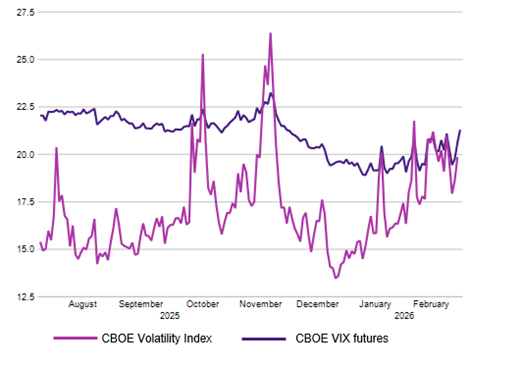
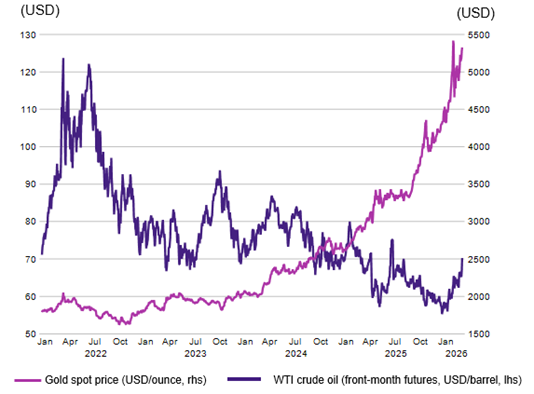
The US and Israeli strikes on Iran that began on 28 February and Tehran’s retaliatory strikes throughout the Middle East triggered a sell-off in Asia equity markets. As of the time of writing, US stock futures have also declined sharply and VIX futures have risen (see Chart 1). Oil prices have surged, while traditional safe haven gold has rebounded to near record highs (see Chart 2).
Chart 1: VIX futures edge up after strikes
Source: Amova Asset Management, Bloomberg
Chart 2: Oil climbs, gold bounces back
Source: Amova Asset Management, Bloomberg
Both equity and bond markets, however, seem to be pricing in a limited conflict. At the time of writing, risk appetite has shown signs of only limited strain. This is surprising, given the immediate scope of the conflict and the uncertainty of the outcome.
For example, the rise in the generic front-month VIX futures has been comparatively modest so far. The rise seen up to now does not appear out of the ordinary, compared to recent history (See Chart 1); higher levels were observed as recently as November 2025. Meanwhile, the futures curve remains in contango formation, with contracts trading above spot—which is characteristic of times of contained volatility, rather than the backwardation that accompanies episodes of systemic volatility. However, this may change in future sessions and is worth watching as a sentiment indicator.
For Japanese equities, the US-Israeli attack on Iran does not appear to be the sole risk factor weighing on sentiment. Weakness in financial sector stocks was attributed by the media only partly to the rise in geopolitical risk. The weakness also reflects shifting expectations around the Bank of Japan’s rate hike trajectory, growing concern over the health of credit markets and uncertainty over domestic fiscal policy credibility.
Notably, the yen, a traditional risk haven, remains mostly unaffected by the strikes. This indicates that either (a) risk aversion has yet to rise to a level that would prompt broad-based unwinding of the yen-funded “carry trade”, with markets foreseeing the escalation of geopolitical tensions as unlikely to lead to a wholesale collapse in risk appetite; or (b) that Japan’s cash-hoarding days are over, and that geopolitical tensions, with their potentially inflationary implications and pressure on real interest rates, may undermine the yen’s value in the absence of future rate hikes.
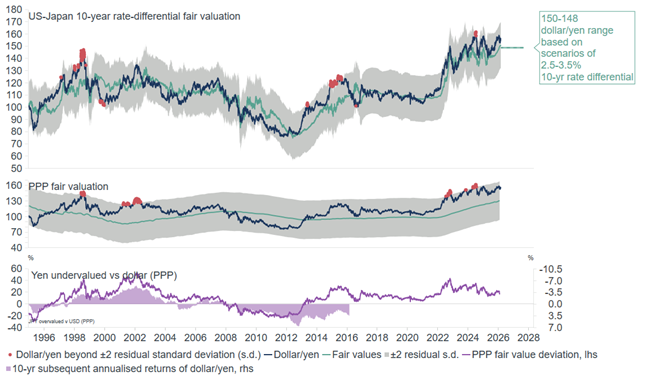
That said, as Chart 3 shows, dollar/yen is above “fair value” on both long-term and shorter-term measures, implying that the yen remains undervalued.
Chart 3: Dollar/yen above “fair value”
Source: Macrobond, US Treasury, BLS, SBJ
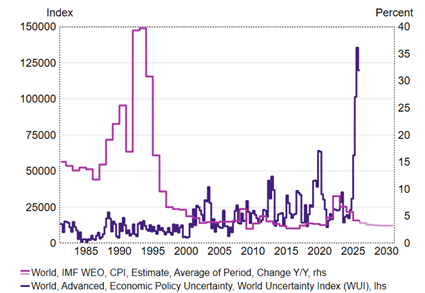
In the longer term, the relationship between uncertainty and prices remains a key factor of the outlook for risk assets, as well as both for the dollar and the yen. The recent increase in volatility remains modest compared to many measures of economic uncertainty (see Chart 4), and there is some evidence that a rise in different types of policy uncertainty tends to foster, with some lag, higher inflation*.
Chart 4: Latest volatility increase remains modest relative to many measures of economic uncertainty
Source: Amova AM, Economic Policy Uncertainty, International Monetary Fund
It is therefore possible that the markets have yet to fully price in this shift, even though the risk reaction so far has been relatively muted. It would be unwise to discount the potential for further volatility ahead.
* For example, see. Dreschsel, 2024 (on uncertainty surrounding political pressure on the Fed) and Gavriidis, 2026 (which finds effects consistent with a supply-side shock in climate policy uncertainty).