

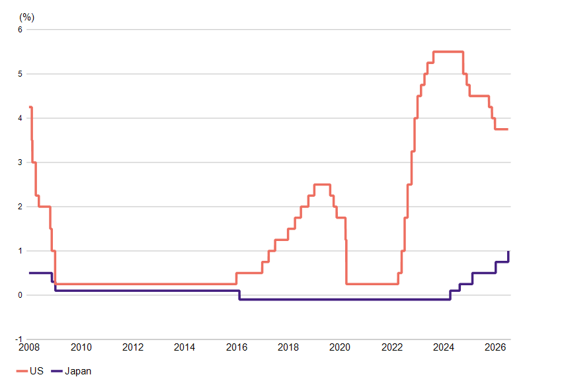
As widely anticipated, on 16 June the Bank of Japan (BOJ) hiked the overnight call rate by 25 basis points (bps) to 1.00%, its highest level since 1995. The hike itself was well-signalled and priced into the market beforehand.
Rate hike plus taper pause: hawkish today, less so tomorrow
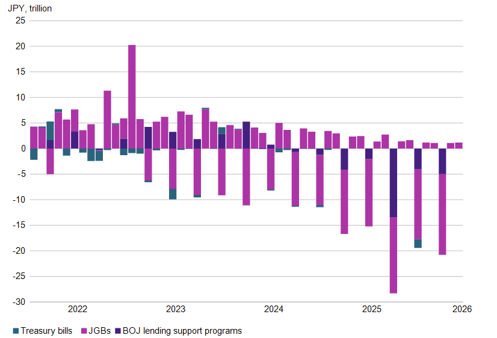
The central bank also signalled that it will continue reducing its monthly Japanese government bond (JGB) purchases through March 2027, after which purchases will be maintained at around Japanese yen (JPY) 2 trillion per month. This is an advance announcement of a halt to the BOJ’s bond purchase taper, rather than a signal that Quantitative Tightening (QT) is coming to an end. Holdings may still shrink through passive runoff—where holdings are allowed to mature without reinvestment rather than actively sold off—as maturities could exceed the monthly JPY 2 trillion of monthly purchases. However, the move may serve as a pressure valve to support super-long JGBs following the recent rise in yields. Meanwhile, forward guidance remains oriented toward normalisation. The BOJ continues to signal that it will raise rates depending on the economy, prices and financial conditions. At the same time, its emphasis on timing and pace also signals gradualism rather than urgency to the markets.
Key dissents send a modestly mixed signal
In sum, the BOJ’s policy decision favours the ongoing withdrawal of accommodation—policy rates are still on a rising trajectory, while its balance sheet will still shrink over time. However, the pace of normalisation appears to be a point of internal debate. The decision to hike rates passed by a 7-1 vote, with new board member Toichiro Asada dissenting, which may be interpreted as dovish. Meanwhile, board member Naoki Tamura dissented on the bond purchase plan shift, which may be interpreted as hawkish.
Chart 1: BOJ’s balance sheet trends (JPY)
Source: Amova Asset Management, BOJ
Macro credibility: dialogue with the market remains critical
Although the BOJ’s latest move, on balance, reinforces its inflation-fighting stance, questions around its longer-term commitment remain. As we mentioned above, the arc of BOJ policy continues to point towards withdrawal of accommodation. However, whether the pause in tapering may eventually be read as a step towards monetisation of government debt by the central bank remains an open question.
The BOJ’s longer-term reaction function—particularly if inflation diverges to the upside—remains a key uncertainty. This is a risk that the central bank acknowledged in its public comments. As a result, markets may continue testing the BOJ’s resolve, which means that super-long JGBs are not yet out of the woods.
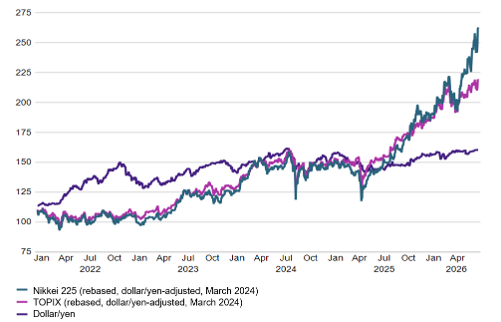
Chart 2: Nikkei 225 and TOPIX, rebased relative to dollar/yen as of 19 March 2024
Source: Amova Asset Management, Macrobond
Note: Rebasing both the Nikkei and TOPIX relative to dollar/yen as of the end of the BOJ’s Negative Interest Rate Policy (NIRP) in March 2024 shows how risk tolerance has exceeded the yen’s depreciation since then.
Yen, equities: carry remains the theme of the day
The subsequent surge in Japanese equities following the BOJ’s announcement suggests that a 25 bps hike is not enough to deter risk-taking. Likewise, the muted reaction in dollar/yen, which is holding steady around the 160 level at the time of writing, also contrasts significantly with the retreat in the trade-weighted dollar (DXY).
Only recently, the parallel rise in dollar/yen and oil prices had been seen to reflect heightened demand for petrodollars (a type of risk-aversion signal). Against this backdrop, the current price action points to some inconsistency in the market narrative around dollar/yen. What is clear, however, is that risk tolerance remains high and carry remains dominant.
Chart 3: Japan, US policy rates (%)
Source: Amova AM, BOJ, Federal Reserve
Fed signalling in focus
Fed policy remains another near-term focal point, and markets are similarly likely to look beyond the upcoming meeting to gauge the Federal Open Market Committee’s reaction function, while also evaluating incoming Chair Kevin Warsh’s messaging. Although the potential for a negotiated settlement in the Iran-US conflict may ease immediate pressures from oil prices, the potential for lagged effects from previous supply disruptions remains. This could complicate the inflation outlook and may make it difficult for central banks to abandon their caution regarding inflation.