


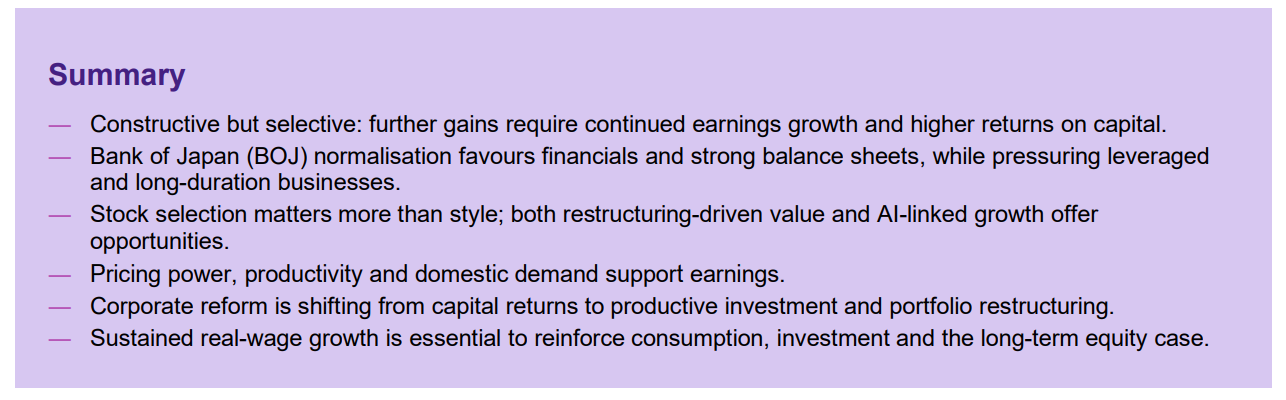
Sustaining earnings growth and higher returns on capital
Japanese equities enter 2027 after performing strongly over the past four years, supported by corporate governance reform, improving capital efficiency and a more durable inflation environment. Greater political clarity under the government led by Sanae Takaichi, Japan’s first female prime minister, has also reinforced confidence in the country’s economic outlook.
Now that Japanese equities have found their footing over the past few years, the investment question has shifted. It is no longer simply whether Japan is changing, but whether those changes can translate into sustained earnings growth and higher returns on capital.
We remain constructive on Japan amid this evolving economic backdrop. As we focus on 2027, we expect to see moderate nominal GDP growth, supported by higher wages and inflation, giving companies greater scope to raise prices and revenues than during the deflationary era. Persistent labour shortages are also likely to accelerate investment in automation, software and productivity.
However, the starting point is becoming more demanding. Earnings growth has driven the market over the past 12 months, so further upside will require continued EPS growth and/or a re-rating supported by higher returns on capital.
BOJ normalisation: a shift in relative winners
We expect further monetary policy normalisation to be one of the most important drivers of Japanese equities in 2027.
In theory, higher interest rates create a valuation headwind, particularly for businesses whose valuations depend heavily on cash flows expected far in the future. Yet the broader signal from normalisation gives us more confidence: Japan is moving further away from the low-inflation, low-growth environment that prevailed for much of the past three decades.
Policy normalisation will have mixed effects. Financials are expected to benefit from a more normal interest-rate structure, while cash-generative companies with strong balance sheets are also seen to be relatively well positioned. Conversely, highly leveraged businesses, companies dependent on external financing and expensive long-duration equities, which are often found in the technology sector, may face headwinds.
For investors, BOJ normalisation does not weaken the structural case for Japanese equities. Rather, it increases the importance of valuation discipline, balance-sheet strength and earnings quality. Japan’s many cash-rich companies are also expected to put their capital to work as inflation persists and interest rates rise, helping to unlock value.
Value versus growth: increasingly a stock-selection market
The sharp style rotations seen during 2026 underline the difficulty of making an overly binary value-versus-growth call. In the first half of 2026, we saw substantial outperformance by large-cap value in the first quarter, followed in the second quarter by a sharp reversal in favour of large-cap growth.
We expect both styles to retain support in 2027. The key, in our view, is stock selection.
For value, catalysts continue to come from monetary normalisation, improving capital allocation, capital-structure optimisation and greater pressure to restructure low-return businesses.
For growth, Japan retains important competitive positions in semiconductors, factory automation, advanced materials and other areas benefiting from AI and digital-infrastructure investment, including the so-called picks and shovels opportunities. These opportunities are often found in areas beyond technology, such as machinery, materials and energy.
We therefore expect 2027 to be less a style market and more a stock-selection market. As a result, the more useful distinctions in 2027 may be value creators versus value traps, profitable growth versus expensive growth, pricing power versus margin pressure, and productive capital deployment versus passive cash accumulation.
The next phase of corporate transformation
Corporate transformation remains central to the Japan equity case, but its character is changing.
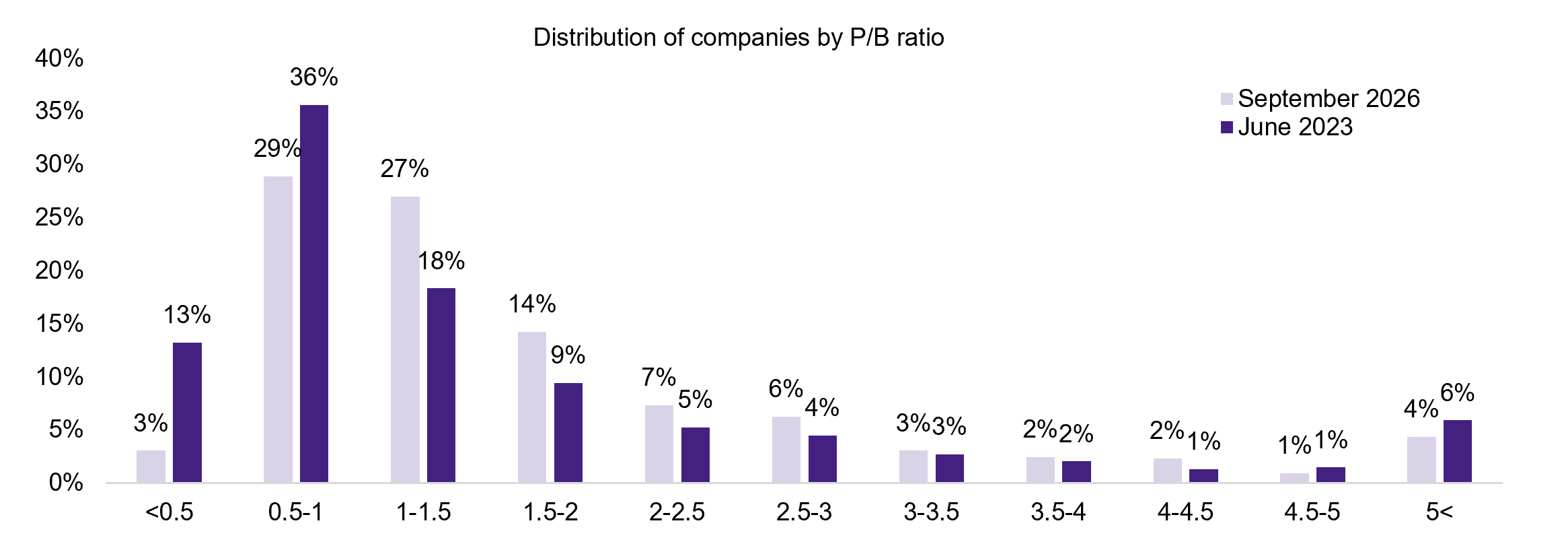
The first phase of reform focused primarily on capital efficiency: reducing cross-shareholdings, raising dividends and buybacks, and increasing management awareness of the cost of capital. These changes have been significant, but improved distributions alone cannot generate sustainable long-term growth.
Chart 1: Fewer Japanese companies trading below book value
Source: Bloomberg
The next phase is more demanding: a shift from returning capital to deploying capital productively.
It is worth noting that cash holdings among TOPIX 500 companies (excluding financials) increased from JPY55 trillion in FY2013 to JPY124 trillion in FY2025, while investment in areas such as capital expenditure, R&D and human capital remained relatively low.
The next stage of corporate transformation should therefore increasingly focus on investment in businesses with sustainable competitive advantages, R&D and innovation, human capital and productivity, automation, disciplined M&A and the divestment of structurally low-return businesses.
This should translate into two broad management actions: restructuring business portfolios and investing for growth. Portfolio reform can raise expected profitability, improve prospective ROE and support higher P/B ratios by reallocating resources away from underperforming or non-core businesses.
That is particularly supportive of value-oriented strategies focused on companies at which operational or strategic shortcomings have depressed valuations. Growth investment works through a different channel, raising the market’s expectations of sustainable growth and potentially supporting higher valuation multiples.
For this next phase of corporate transformation to translate into sustained earnings growth, we believe the following three structural factors will be particularly important:
- Pricing power. The return of inflation has changed corporate pricing behaviour after decades in which price increases were difficult to implement. Companies with differentiated products, strong competitive positions and pricing power should be better placed to protect margins as wages and input costs rise.
- Productivity investment. Persistent labour shortages are accelerating investment in automation, software and AI. This matters both for companies adopting these technologies and for Japanese suppliers of the equipment, components and materials required to enable them.
- Domestic demand. Sustained real-wage growth would broaden Japan’s earnings opportunity by supporting consumption and reducing the market’s reliance on exports and currency weakness.
The structural test: wages, inflation and investment
The sustainability of the broader Japan story ultimately rests on whether the emerging wage-price-investment cycle becomes self-reinforcing.
For much of the deflationary era, weak pricing power, stagnant wages, conservative investment and excess corporate savings reinforced one another. The emerging cycle has the potential to operate differently:
Higher wages → stronger consumption → pricing power → revenue growth → corporate investment → productivity
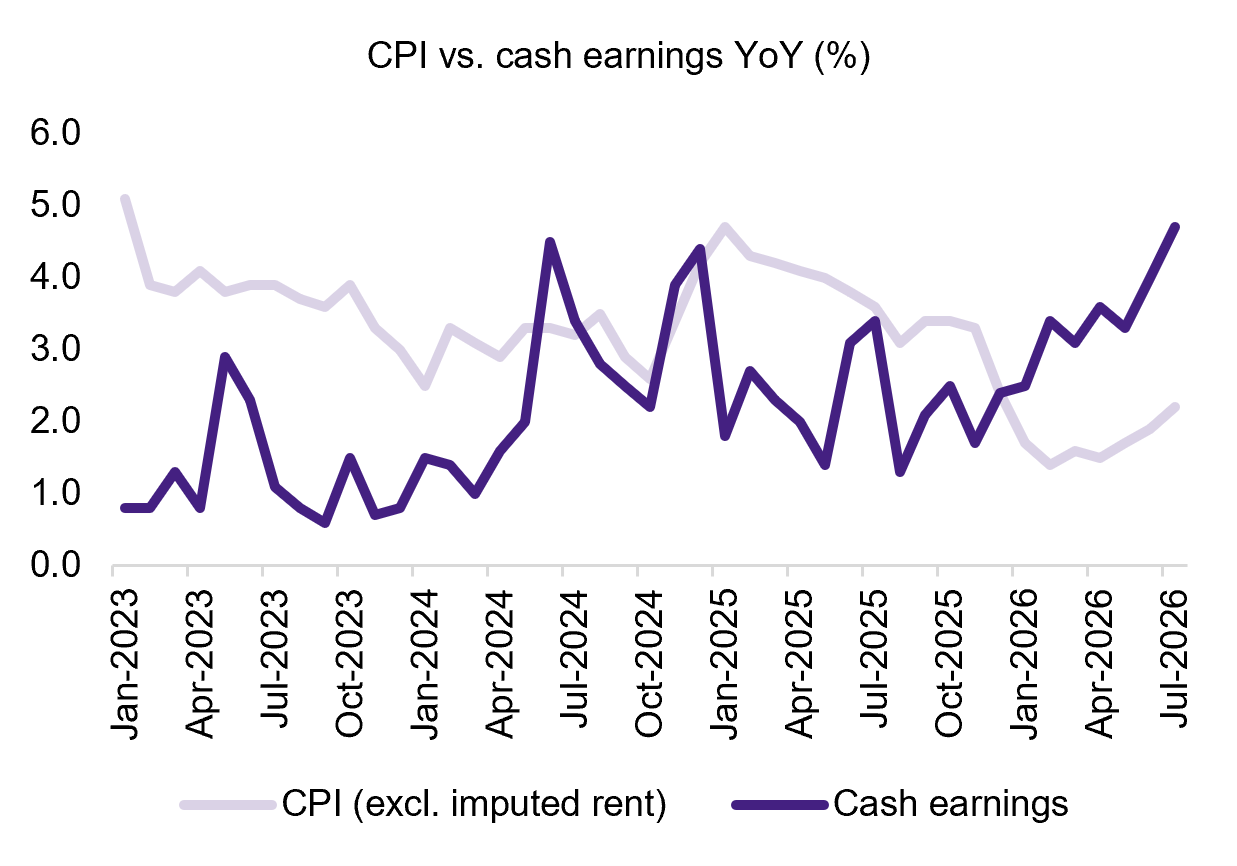
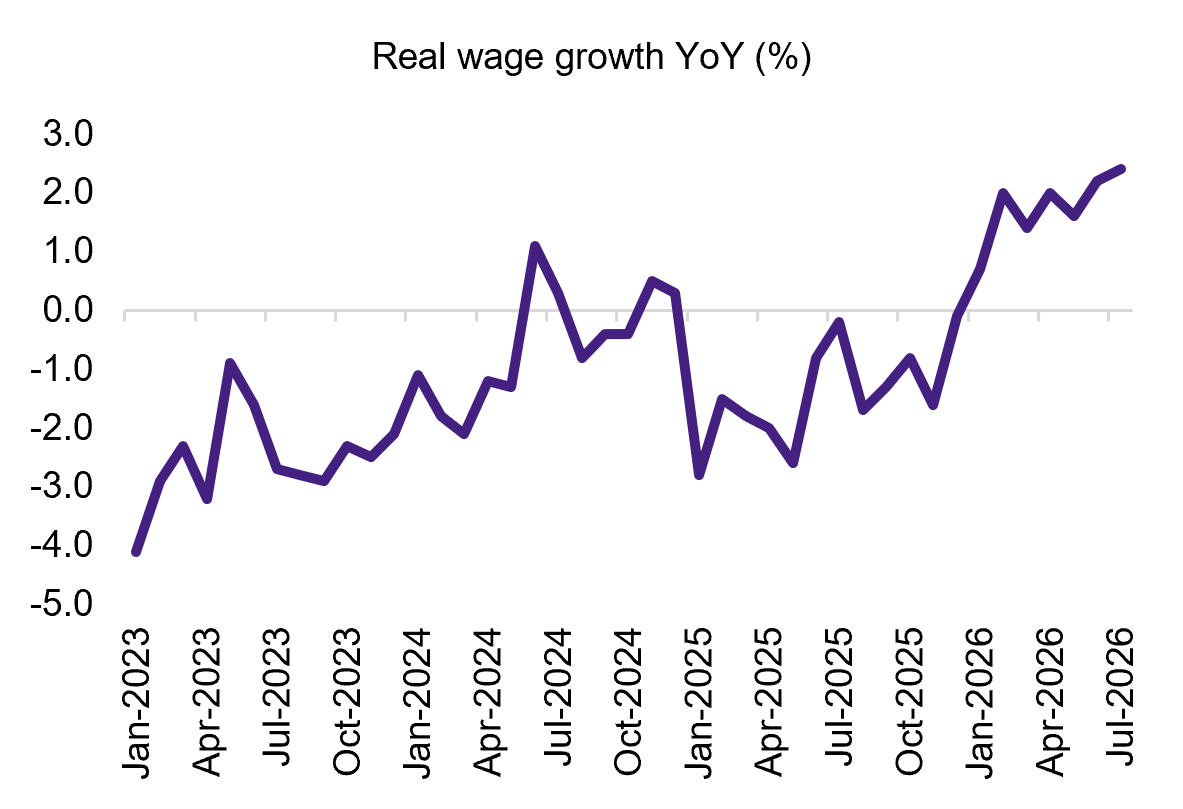
The critical variable is real wage growth. Nominal wage increases alone are insufficient if inflation continues to erode household purchasing power.
Chart 2: Japan’s improving wage-inflation balance
Source: Bloomberg based on data from Ministry of Internal Affairs and Communications and Ministry of Health, Labour and Welfare
Companies also need to offset rising labour costs through productivity improvements and pricing rather than allowing higher costs simply to compress margins.
If this cycle becomes sustainable, the implications extend beyond consumption. A positive nominal-growth environment could strengthen incentives for companies to deploy accumulated cash through productive investment.
This is where Japan’s macroeconomic and corporate-reform stories increasingly converge.
Conclusion
Japanese equities enter 2027 in a position of strength, but the investment case is becoming more demanding. The next phase should be less about validating reform and more about delivering earnings growth, productive capital deployment and sustainable improvements in returns on capital.
We expect BOJ normalisation to increase differentiation across stocks rather than undermine the market structurally, while the traditional value-growth divide may become less useful as company-specific fundamentals reassert themselves. Meanwhile, the evolution from governance reform to genuine business transformation offers a potentially more durable source of corporate value creation.
For active investors, this creates an attractive but more selective opportunity set. We believe that the defining investment question for 2027 will be which companies can convert Japan’s structural transformation into sustainable earnings growth and higher returns on invested capital.