


Predicting interest rates is a dangerous business. As the old saying goes, economists were invented to make weather forecasters look good. With that warning out of the way, we think the outlook for New Zealand interest rates in 2027 is becoming more encouraging.
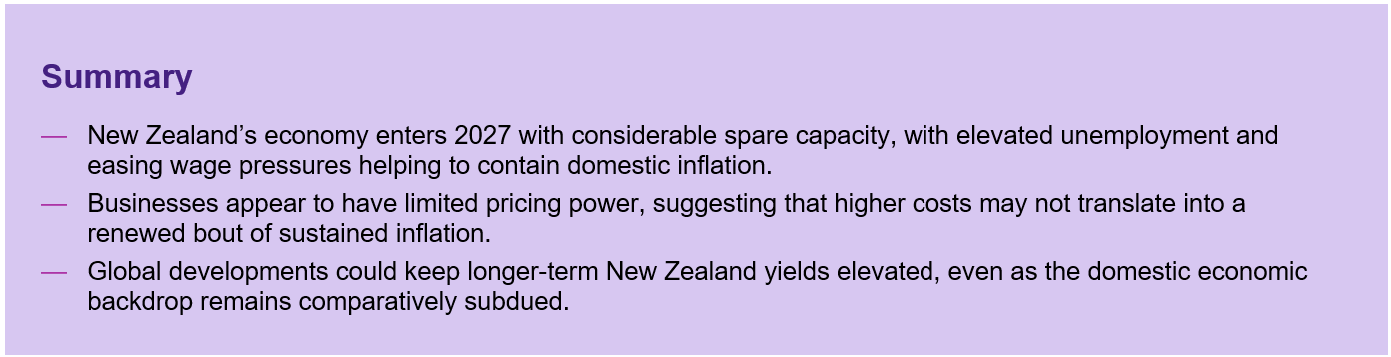
The last few years have been difficult. Inflation surged, the Reserve Bank of New Zealand (RBNZ) lifted interest rates sharply and New Zealand households discovered that refixing a mortgage could be considerably less enjoyable than buying the house in the first place. More recently, global events have kept longer-term interest rates relatively high. However, looking ahead to 2027, we think an important distinction is emerging. Global forces may be keeping interest rates high, but the New Zealand economy itself does not appear particularly inflationary.
That matters for both borrowers and bond investors.
The economy still has plenty of spare capacity
Perhaps the clearest evidence comes from the labour market.
New Zealand's unemployment rate reached 5.7% in the September 2026 quarter, its highest level since 2013. Youth unemployment has also increased significantly. Nobody celebrates higher unemployment, but when thinking about inflation and interest rates, a weaker labour market is significant. When businesses are competing desperately for workers, wages tend to rise quickly. Employees can change jobs for substantial pay increases and employers often pass those additional costs on to customers.
Today, that cycle looks much weaker. The data show wage growth in both the private and public sectors has cooled substantially from recent highs. In simple terms, there are enough people looking for work that employers do not need to keep bidding wages higher. That removes one of the major ingredients needed for another sustained inflation problem.
Wanting to raise prices is not the same as actually doing it
Businesses, unsurprisingly, would often prefer to charge their customers more. Customers, equally unsurprisingly, would prefer that they did not. At the moment, customers appear to have the upper hand. New Zealand business surveys show a significant gap between the number of firms saying they intend to raise prices and the price increases they actually achieve. During 2026, businesses became considerably more willing to contemplate higher prices, but actual price rises remained more subdued.
This distinction is crucial. Higher costs do not automatically create inflation. Businesses need enough pricing power to pass those costs on. If households are watching every dollar, putting up prices can simply mean selling less. That should help contain domestic inflation during 2027.
The complication comes from overseas
Unfortunately, New Zealand does not get to set interest rates in isolation. We are a small country borrowing money in a very large global financial system. Longer-term New Zealand yields can therefore be heavily influenced by what happens overseas, particularly in the US. This means our bond yields can rise even when the New Zealand economy is weak.
And that is an important part of today's opportunity. International forces have helped push New Zealand bond yields higher even though our domestic economy remains comparatively soft. That tension could continue through 2027. Global markets may remain volatile, but that does not automatically mean the RBNZ should respond to every overseas development.
Higher yields are not all bad news
Higher interest rates clearly have not been much fun for borrowers. They have also caused periods of poor performance for bond investors because existing bond prices fall when market interest rates rise. However, there is another side to the story. Today's higher yields mean investors purchasing bonds now are receiving substantially more income than was available when interest rates were extremely low.
Think of it as the silver lining to several grey interest-rate clouds. Higher starting income also provides investors with a bigger cushion against market volatility. If interest rates remain around current levels, investors can continue collecting that income. If the economy weakens further and rates eventually fall, bond prices could rise as well. That makes the starting point for 2027 considerably more attractive than it was when yields were very low.
So, what could go wrong?
Plenty. There is never a shortage of candidates. Another global inflation shock, sharply higher oil prices or unexpectedly strong overseas growth could push global bond yields higher again. New Zealand would inevitably feel some of those effects.
The domestic picture, however, looks different. Unemployment is elevated and will take some time to fall; wage pressures have eased; businesses are having difficulty passing all their proposed price increases on to consumers; and the economy still appears to have considerable spare capacity. None of those conditions point naturally towards a major new outbreak of New Zealand-generated inflation.
Conclusion: what does that mean for 2027?
Our view is cautiously optimistic. We do not think interest rates will necessarily plunge from here, nor do we expect 2027 to be perfectly calm. Financial markets have an impressive ability to find something new to worry about.
But for bond investors, that may be the point. Yields are relatively attractive at a time when the domestic economy is subdued and inflation pressures appear more manageable. Investors are being paid meaningful income while they wait to see which way the economy develops.
For 2027, that combination of higher starting yields, a subdued New Zealand economy and the possibility of lower interest rates creates an increasingly attractive backdrop for bonds. After several difficult years, bonds may finally be getting interesting again. And in fixed income, "interesting" is hopefully about as exciting as it gets.