


Quality returned in 2026. What comes next?
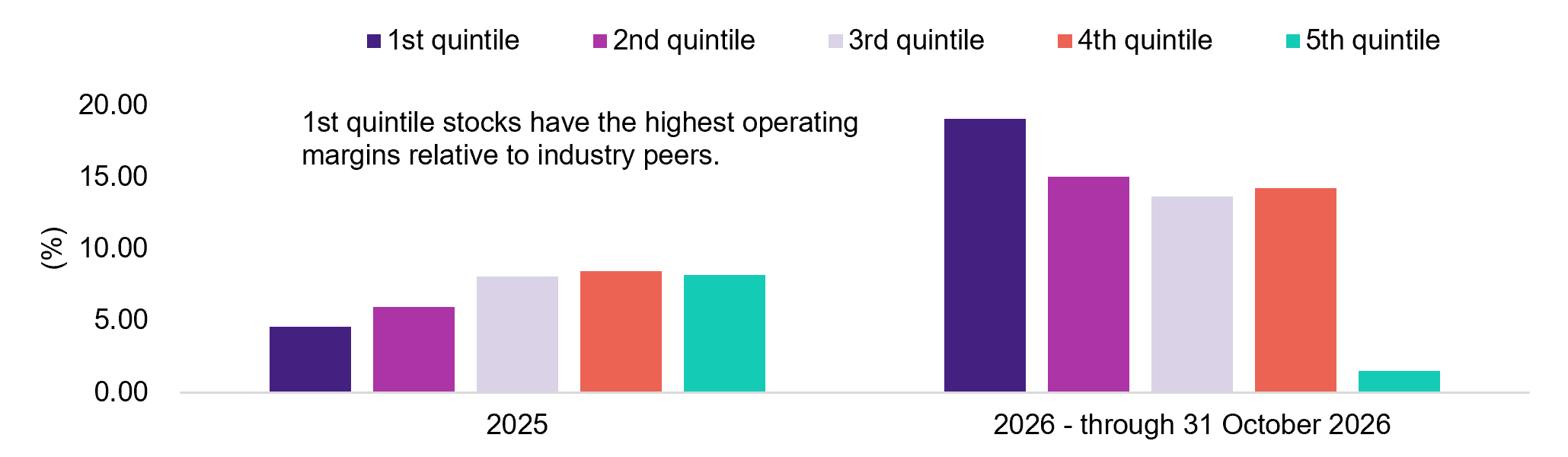
Going into 2026, Amova Asset Management’s Global Equity Team observed that quality stocks had just suffered their steepest underperformance in two decades and that history pointed to a rebound. In US small cap value, that view has broadly played out. In 2025, speculative, lower-quality companies led while profitability, balance-sheet strength and cash generation were ignored. The market became more discriminating in 2026. Operating margin is one example: firms with the highest margins relative to their industry peers have outperformed those with the lowest by a wide margin (Chart 1).
Chart 1: Russell 2000 Value constituents, total return by operating margin quintile
Source: Factset, LSEG Data & Analytics, Amova AM
The question for 2027 is whether this is a one-year correction of the excesses in 2025 or the start of a more durable regime. We believe it is the latter, largely due to the return of a real cost of capital. The “Fed cuts, small caps rally” narrative that framed much of the past two years no longer fits the facts, and we believe that matters more for small companies than for large ones.
Capital has a cost again
The Fed raised its policy rate in September 2026, its first increase since 2023; as of this writing, the futures markets imply the Fed Funds rate rising from roughly 3.9% to about 4.6% by late 2027. Our focus, however, is less on the precise path of monetary policy than on its economic and market consequences.
For small caps, the impact of rates depends less on their direction than on when and at what cost companies must refinance. Compared with large caps, small companies typically have less mature balance sheets, lower free cash flow and greater reliance on outside capital. They also tend to carry more debt, and a larger share of it is floating-rate or shorter-dated. Many small companies are now replacing debt raised cheaply in 2020–2021 with materially more expensive borrowing. Self-funding and low leverage businesses, by contrast, are largely insulated. Higher rates therefore do not lift or sink small caps evenly; they separate strong businesses from weak ones.
History favours quality when capital costs rise
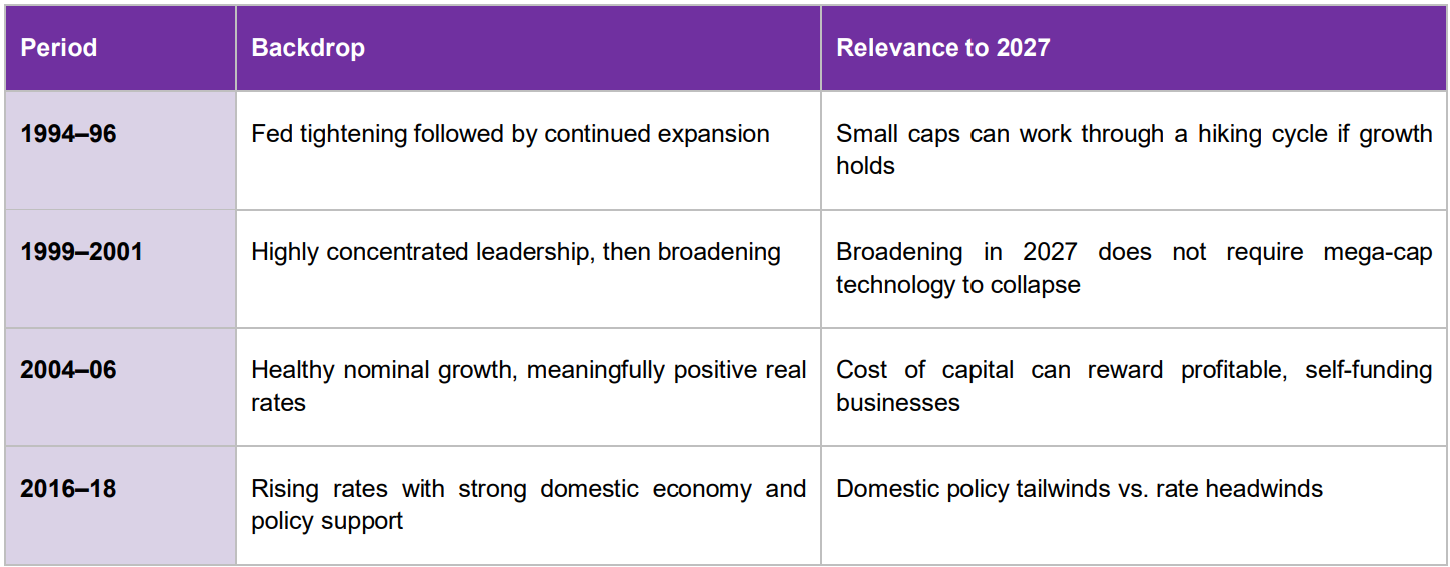
No single period is a perfect analogue, so we test several, asking how higher- and lower-quality US small cap value stocks performed under different cost-of-capital regimes.
Table 1: Historical regimes and their relevance to 2027
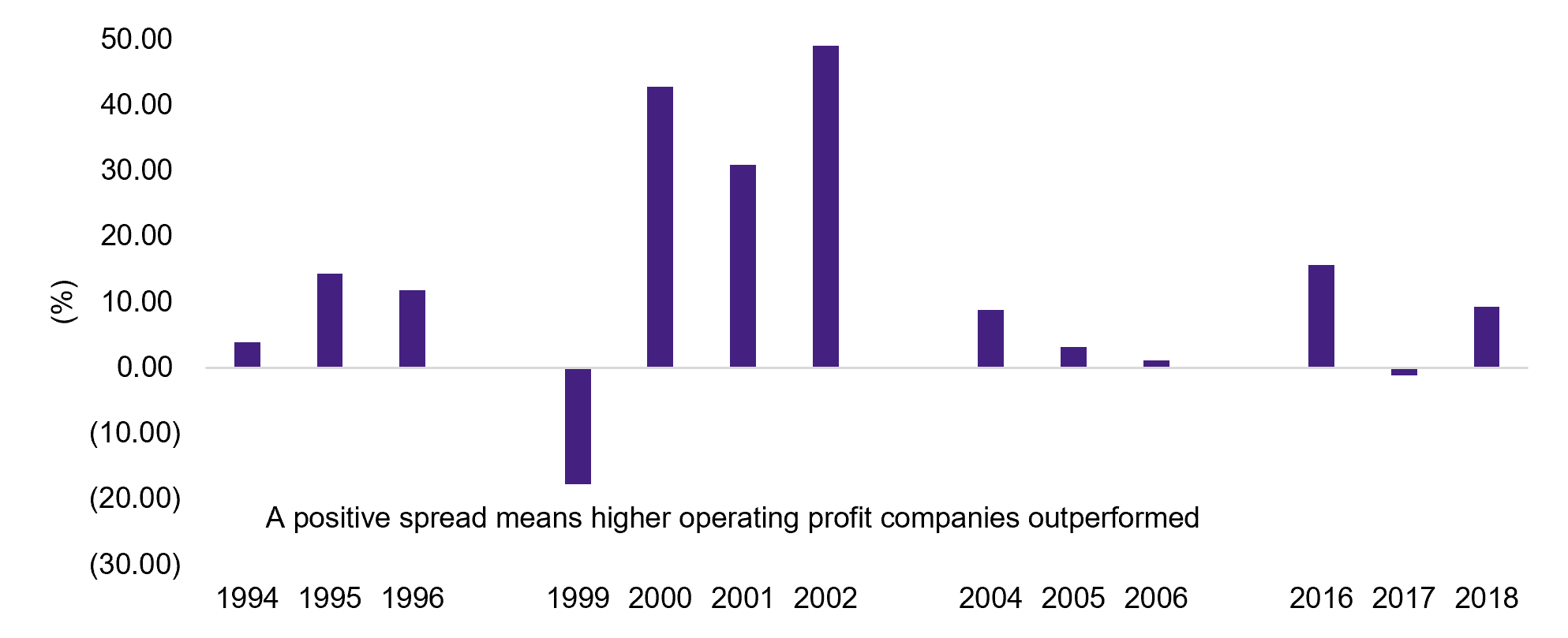
The pattern is consistent: in most of these periods, companies with the highest operating margins outperformed those with the lowest (Chart 2).
Chart 2: Russell 2000 Value constituents, total return of top 20% less bottom 20% by operating margin
Source: Factset, LSEG Data & Analytics, Amova AM
Same economy, different outcomes
Interest rates are only part of the story. The US economy has outperformed expectations in 2026, with business investment as a share of GDP near the top of its historical range, driven by the artificial intelligence (AI) buildout. We expect business investment to continue and broaden in 2027. In small caps, the second-order beneficiaries are capital goods, electrical and industrial services, and power equipment and grid suppliers. The opposite risk sits with service businesses built on lower-cost labour, such as outsourcing, staffing and IT services, whose work AI may increasingly automate.
The energy shock is creating a similar split. The conflict involving Iran remains the main source of inflation risk. Brent crude has ranged from roughly US dollar (USD) 70 to USD 118 per barrel since February 2026, Persian Gulf flows, while they have recovered, remain at only about 80% of pre-conflict levels and refined products remain constrained. The disruption extends to liquefied natural gas, fertiliser and helium, adding cost pressure in chemicals, agricultural inputs and transport. Higher input costs fall hardest on thin-margin, leveraged businesses, which widens the same gap rising rates are already creating.
Meanwhile, expectations are high for small caps. Consensus estimates call for small-cap earnings per share to grow 37.9% in 2027, versus 15.8% for large caps. That supports a constructive view of the asset class, but it also raises the bar. With growth this uneven across industries, meeting those expectations will be a company-by-company exercise.
A distinct exposure for global investors
For non-US investors, US small caps are not simply a smaller version of the S&P 500. Global indices are heavily concentrated in a handful of US technology giants, while US small cap value is driven by domestic demand, regional banking, industrial activity, US policy and the cost of capital. Because these companies earn most of their revenue at home, they are less exposed to global trade disruption than small caps elsewhere. Nearly 90% of oil passing through the Strait of Hormuz flows to Asia, leaving the US relatively insulated, although companies that rely on Asian supply chains still carry disruption risk.
The trade-off is greater sensitivity to US interest rates and fiscal policy. With markets also pricing further tightening by the European Central Bank and the US dollar holding firm, currency is part of the return for non-US investors, and hedging decisions deserve explicit attention.
Conclusion: a favourable environment for active value
In our view, a meaningful cost of capital, widening fundamental dispersion and a broadening economy should create a more favourable backdrop for active value investing. We believe 2027 will be a market in which valuation and fundamentals matter increasingly at the company level, creating greater opportunity for disciplined stock selection. For global investors looking beyond concentrated mega-cap leadership, US small caps offer not just diversification, but a broader opportunity set in which selectivity can make a meaningful difference.