


Japan became one of the first global financial flashpoints of 2026 when 30- and 40-year Japanese government bond (JGB) yields surged to record highs, with the rise rippling across global bond and currency markets. The immediate trigger was Japanese Prime Minister Sanae Takaichi’s decision to dissolve the lower house and call for a snap election in a bid to consolidate her party’s political standing. Fiscal concerns hit the JGB market on the prospect of the government increasing debt issuance to fund Takaichi’s campaign pledges, which included suspending the 8% consumption tax on food.
The recent JGB market shakeout was concentrated in the relatively illiquid 20–40‑year sectors and price action was thus amplified relative to actual fundamentals. It would therefore be inaccurate to describe the bond market as being in a systemic crisis. Yet the signals from JGBs—about fiscal credibility, political coordination and market tolerance—still matter beyond Japan.
What actually moved and why it looked so dramatic
The sharpest moves occurred in the 20–40‑year super‑long JGBs. As super-longs occupy a part of the curve dominated by domestic life insurers and characterised by lower liquidity, they are susceptible to outsized swings on relatively small flows, especially around weak auctions or when insurers pull back bids. This explains why the price action around 19–20 January looked outsized relative to macro fundamentals, drawing comparisons to the “Truss shock” the UK experienced in 2022 and causing it to be described (inaccurately) by many media outlets as a market “meltdown”.
There are two points to consider:
- First, the turbulence was concentrated in the super-longs and should not be viewed as a wholesale flight from JGBs. For example, the simple yield on the 40-year JGB, which soared to a record high above 4.2% on 20 January, has subsequently eased back below 4.0% after reports that the ruling party was not fully unified regarding tax cuts. This shows that the super-longs are sensitive to headlines and that the dramatic moves were not a result of systemic stress.
- Second, direct pass-through is limited. Corporate loans and mortgages do not primarily price off 30–40‑year JGBs—in another words, the impact of super-long sector fluctuations on the broader economy is limited.
That said, signals from the super-long JGB sector were real. As Japan braces for political change, the JGB market may prove to be an effective mechanism to enforce fiscal discipline without the need for actual bond market failure. This is particularly important as post-election fiscal policy is likely to remain expansionary, with tax cuts being combined with higher spending to keep fiscal risk premia elevated. Election uncertainty is unusually high as the ruling Liberal Democratic Party is heavily reliant on Takaichi’s personal popularity and no longer has the support of Komeito, its one-time coalition partner.
Is Japan nearing a fiscal breaking point?
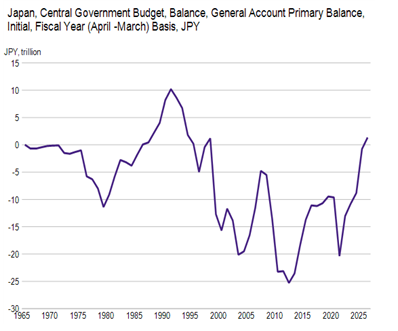
As Japan’s fractured political landscape raises tail risks, immediate market focus is on whether any post-election administration can outline a stable fiscal plan amid promises of stimulus and tax relief. The markets are not saying Japan cannot pay its debts—the country’s debt-to-tax revenue ratio has improved markedly over recent years. Rather, they are currently pricing the risk of poor fiscal coordination as the various parties attempt to put together credible fiscal narratives. Japan’s nominal conditions still support funding, but fiscal discipline is at risk of drifting. Credibility will be re‑established either through a clear election mandate or, failing that, through a more forceful response from the bond market.
Chart 1: Japan’s fiscal situation is better than before thanks to tax revenue
Source: Amova AM, Japan Ministry of Finance
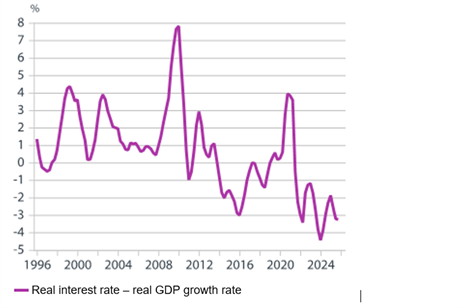
Any administration that emerges after the election should note that Japan’s funding conditions could easily deteriorate if the rise in the real interest rate is not kept in check. Chart 2 illustrates the relationship between the real interest rate and the real GDP growth rate, which is a fundamental determinant of a country’s fiscal sustainability.
Chart 2: Japan’s real interest rate – real GDP growth rate
Source: Amova Asset Management, BOJ, CAO
Not fiscal dominance—BOJ independence is intact
The possibility of Japan employing greater fiscal stimulus naturally raised the probability of inflation overshooting the BOJ’s 2% target. Against this background the BOJ has been described as being “behind the curve”. However, the perceived lag is not fiscal dominance. A central bank answering the government’s financing needs would be capping the yield surge to suppress borrowing costs; instead, the BOJ allowed volatility in super-long JGBs to play out. Furthermore, the BOJ stands ready to tighten monetary policy if it sees greater inflation risks. Central bank independence has not been lost, and we must distinguish between its temporary tolerance of volatility from loss of control.
The yen carry trade and implications for global markets
The fiscal warning signals from JGBs were heard by the currency market, which reacted by selling off the yen aggressively in January. As the BOJ could step up its tightening to curb the yen’s depreciation, the markets’ thoughts turned to the possibility of carry trade dynamics being altered. A cheap yen has been one of the last reliable sources of the global carry trade, providing investors with low‑cost funding to deploy into higher‑yielding assets. But if the BOJ is forced towards more aggressive rate hikes, that cheap funding base would begin to shrink, in turn affecting risk asset markets.
It is also worth remembering that carry trade is not defined by yield differentials alone—volatility and funding conditions are equally important. When market volatility rises or funding becomes less predictable, the economics of carry can change quickly, and relative yields stop being reliable guides to currency behaviour.
Another layer to consider is the possibility, raised by some major asset managers, that the dollar could soften as investors demand a higher risk premium. The yen, by contrast, has far less room for an additional risk premium because it has been a funding currency. Combine a weaker dollar with a BOJ that acts more aggressively against inflation, and you have the ingredients for a carry‑trade unwind. Global risk assets have benefitted from yen carry and low funding volatility; a sudden unwind could transmit stress across equities, credit and emerging market bonds, particularly if it leads to higher corporate funding costs. At this juncture, the unwinding of carry is not imminent. Still, it is a tail risk that needs to be watched closely since it could snowball quickly once set in motion.
Conclusion
Recent volatility in super‑long JGBs may not signal a systemic bond crisis, but it does highlight the growing sensitivity of the markets to Japan’s fiscal credibility and political developments. As election uncertainty intensifies with various parties making stimulus promises, investors may demand clearer assurances that policy discipline will hold. The BOJ tolerating volatility while retaining its policy independence adds another layer of complexity, particularly for the yen carry trade—a key pillar of global risk appetite. While an abrupt carry trade unwind is not imminent, the events of January make Japan’s political and fiscal developments a global market variable to be closely watched.